Expert Opinion

By
Mel Sheppard
//
27 March 2026
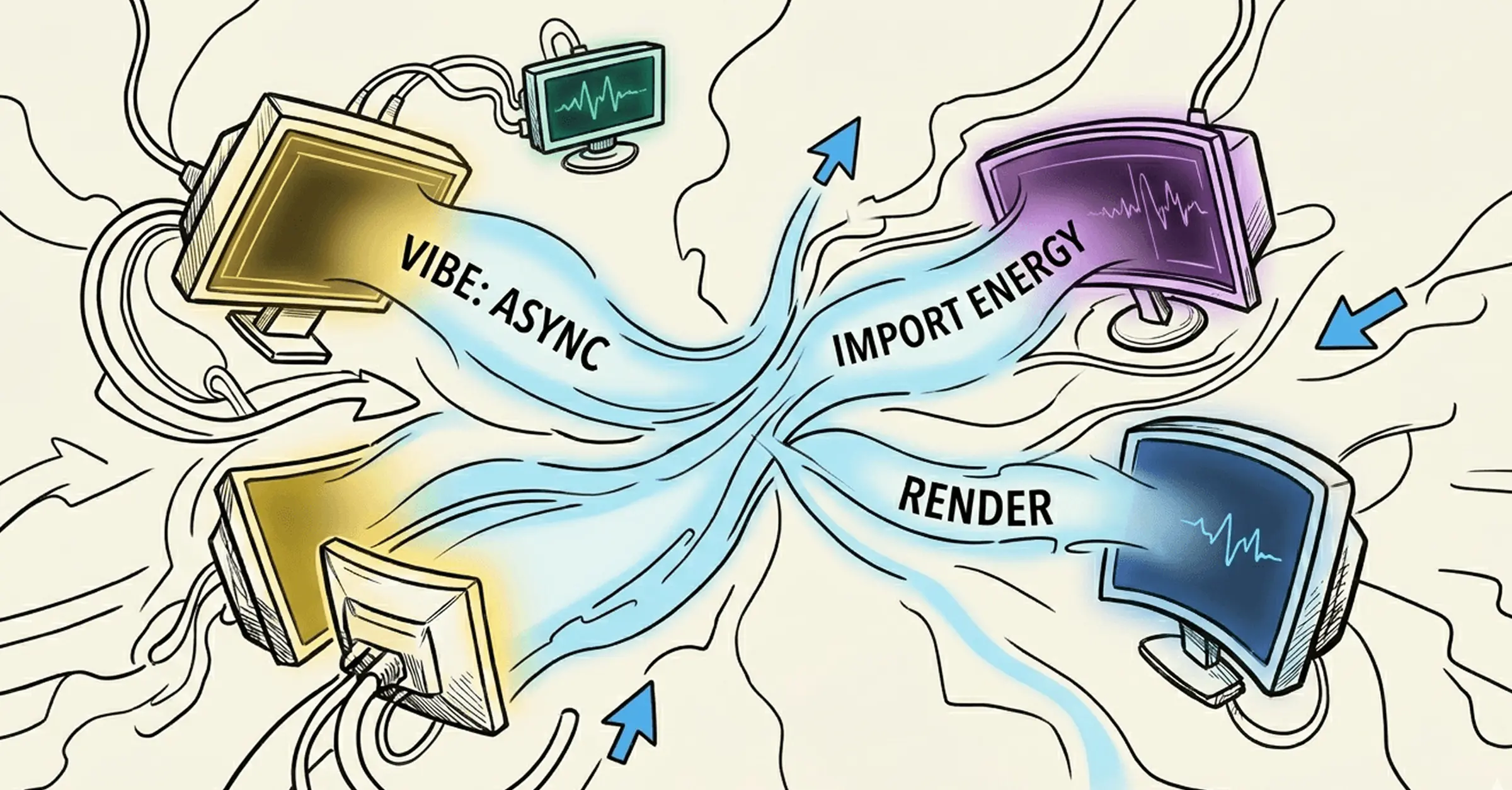
A tweet sparked it. A dictionary made it official. And now it is reshaping how people think about building software.
Vibe coding went from niche concept to Collins Dictionary Word of the Year in under twelve months. If you have not looked into it yet, you are not behind, but it is worth understanding, because it is changing what is possible for people who want to build tools without a development background.
This post explains what vibe coding actually is, how it works in practice, where it genuinely delivers, and where it tends to fall apart.
Vibe coding is a way of building software by describing what you want in plain language and letting an AI generate the code for you. Instead of writing syntax line by line, you tell the AI what you need, and it handles the implementation. If something breaks, you describe the problem and ask the AI to fix it. The code itself becomes almost incidental to the process.
The term was coined by Andrej Karpathy, AI researcher, OpenAI co-founder, and former head of AI at Tesla, in February 2025. His original framing was deliberate: "you fully give in to the vibes, embrace exponentials, and forget that the code even exists." The point was not just speed. It was a fundamentally different relationship with code, one where the output matters more than the implementation.
The idea resonated immediately. Within months, it had moved well beyond hobbyist experimentation. By early 2026, the vast majority of professional developers were using AI coding tools regularly, and a significant proportion of all new code being written was AI-generated.
The process is more iterative than it might sound. It is not a case of typing one sentence and receiving a finished app. In practice, it tends to follow a loop:
Describe: you write a prompt explaining what you want to build. The clearer and more specific the prompt, the better the output. Vague instructions produce vague results.
Generate: the AI produces code based on your description. Depending on the tool, this might be a complete working application, a single component, or a script. You do not need to understand the code to proceed.
Test: you run the output and see what works and what does not. Bugs are common at this stage, particularly with anything beyond a straightforward use case.
Iterate: you describe the problems to the AI and ask it to fix them. You repeat this loop until the output does what you need.
The key distinction from traditional development is that you are directing the outcome rather than writing the implementation. The AI handles syntax, structure, and the mechanical parts of building. You handle intent, requirements, and judgement.
Vibe coding genuinely opens up software creation to people who could not have built tools before. That is not hype, it is the practical reality for a growing number of non-developers who are shipping working applications without writing a line of code themselves.
It tends to work well for:
It is a less natural fit for:
The range is broader than most people expected a year ago. Vibe coding tools have been used to build:
The honest caveat is that many of these work well at the prototype stage and become harder to manage as requirements grow. What starts as a quick experiment can quietly become something business-critical, and at that point, the fragility of AI-generated code becomes a real problem rather than a theoretical one.
Vibe coding has attracted both genuine enthusiasm and well-founded criticism. Both are worth understanding.
The case for it: speed is real. A non-developer can have a working prototype in hours that would previously have taken weeks of engineering time. For contained, low-stakes tools, that is an enormous unlock. The barrier between having an idea and having something testable has dropped dramatically.
The case for caution: AI-generated code tends to be harder to maintain, more prone to duplication, and more likely to contain security vulnerabilities than code written by an experienced developer. Research has found that AI-generated code has significantly more security issues than human-written code, including vulnerabilities that would expose user data. These are not edge cases; they are documented patterns that emerge at scale.
The practical position most teams are landing on is somewhere in between: vibe coding for speed and prototyping, human review and judgement for anything that needs to be reliable, secure, or maintained over time.
These two approaches are often mentioned in the same breath, but they are meaningfully different.
Vibe coding produces actual code, written by an AI, but code nonetheless. You end up with a codebase that you may not be able to read, debug, or maintain without going back to the AI. The flexibility is high; the dependability depends on the quality of what the AI produced.
No-code platforms produce structured applications built within a defined system. The logic is visible to the person who built it, the output is designed to be maintained, and the constraints of the platform are also what make it reliable. You are working within limits, but those limits are why the result holds up over time.
For analysts, consultants, and operations teams building tools they need to share and maintain, not just prototype and move on, that distinction matters quite a lot.
Vibe coding is not a passing trend. It is a genuine shift in how software gets built, and it will continue to evolve quickly as the underlying AI models improve. The honest position is that it is a powerful tool with real limitations, and understanding those limitations is what separates people who use it well from people who get caught out by it.
If you want to go deeper on the specific tools and how to use them effectively, there are good practical guides available. And if you are trying to decide whether vibe coding or a no-code platform is the right fit for what you are building, our no-code explainer is a useful place to start.
Do I need any technical knowledge to vibe code?
Not to get started. The tools are designed for plain-language input. That said, the people who get the best results tend to have some logical thinking skills and can describe what they want clearly and specifically. The less precise your brief, the less predictable the output.
Is vibe coding safe to use for real applications?
It depends on the application. For internal prototypes and low-stakes tools, the risk is manageable. For anything handling user data, payments, or sensitive information, AI-generated code should be reviewed by someone who can read it before it goes anywhere near production.
Will vibe coding replace developers?
Not in any straightforward sense. It is changing what developers spend their time on, with less focus on boilerplate and more on architecture, review, and judgement. The engineers who tend to do well with vibe coding are the ones who understand code well enough to catch what the AI gets wrong.


GET STARTED
Sign up, get building, and pay when you’re ready to launch.